History
The following is an excerpt from an article by Mercedes B. Concepcion in the Philippine Population Review (PPR) Volume 6 Number 1 (2007) issue. Read the full version here.
The Beginnings

In early 1955, Dr. Philip M. Hauser, founder of the University of Chicago’s Population Research Center, one of the world’s leading centers for the study of demography, visited the Philippines upon the invitation of Dr. Meredith B. Givens, Principal Statistical Advisor, University of the Philippines Statistical Training Centre (UPSTC). He addressed the members of the Philippine Statistical Association at one of its monthly meetings. I was then a Research Assistant, the first Filipino to have been appointed to the UPSTC’s research staff upon my arrival from training in Biostatistics in Australia on a Colombo Plan fellowship. A few months later I met Dr. Hauser again, this time at the Seminar on Population Problems of Asia and the Far East organized by the United Nations (UN) in Bandung, Indonesia in November 1955. Historically, it was the first seminar on the subject of population organized by the UN.
The seminar was the first to focus attention on increasing population trends within the region covered by the Economic Commission for Asia and the Far East (ECAFE), now Economic and Social Commission for Asia and the Pacific (ESCAP). The seminar participants realized that the rising population growth rates largely negated or probably even retarded the effects of national socio-economic programs that provided an environment conducive to lowering birth rates. An important outcome of the seminar was a recommendation that the UN take the initiative in setting up a regional demographic training and research centre in the ECAFE region. Consequently, the Demographic Training and Research Centre (DTRC) was established in 1956 at Chembur, Bombay, India. The Centre was jointly operated by UN and the Government of India. Its first Diector was Dr. C. Chandrasekaran.
In November 1962, the Ford Foundation sent out a population survey mission to East and Southeast Asia composed of Dr. Hauser, Dr. Dudley Kirk and Dr. Oscar Harkavy of the Economic Affairs Program of the Ford Foundation. The mission visited the Philippines to look into the feasibility of establishing a demographic center or a population institute at UP. Dr. Virata, then Acting Director of the UPSTC, was very receptive to the idea, provided that the University be given time to train a number of people for the work to be undertaken and provided further that it receive sufficient financial support both from the Philippine government and from outside sources such as UN and private foundations. He promised the mission members that during the ensuing year he would try to assess how long it would take the University to carry out the preparatory steps in order that a population institute be established in the Manila campus or in Diliman. Dr. Virata’s optimism in UP’s ability to establish a population institute, provided sufficient financial support was available, was due to the fact that the country as a whole was better prepared to organize the institute as far as trained personnel was concerned than in 1953 when UP agreed with UN to establish a Statistical Training Centre with UN financial support. In 1962, there were about six persons who had had formal training in demography, one of them at the Ph.D. level, and the others with demographic training either in the United States or at the Bombay DTRC. No such similarly trained people in statistics were available when UPSTC started operations in June 1954. Dr. Virata also informed the Ford mission members that assistance would be needed during the preparatory period in the form of research grants and funds for graduate fellowships.
On 15 May 1963, Acting UP President Virata, in Memorandum No. 368, established a committee in demography in the Graduate School of Arts and Sciences composed of representatives from each of the following disciplines: sociology, demography, economics, geography and social psychology. Membership in this committee was for two years, renewable for a similar term upon recommendation of the Dean of the Graduate School and upon approval of the University President. The committee was to recommend matters pertaining to faculty development, research, fellowships and scholarships. Following a series of meetings, the committee formulated and recommended the adoption of the requirements for an M.A. (Demography) program. Such a program was approved by the University Council at its 221st meeting held in September 1963. There was reason to believe that such a program would attract students, gain the cooperation of official agencies and attract appreciable public interest and support. The committee was to function until the time when the Population Institute will have developed its full complement of staff.
Dr. Virata suggested to then UP President Carlos P. Romulo that the Population Council or the Ford Foundation be requested to send a short-term consultant at the end of 1963 or early 1964 principally to assist UP in drafting an agreement that would be presented to the Government and the Foundations for final approval. Dr. Virata suggested that Dr. Hauser be tapped for this assignment since the latter had indicated a desire and a willingness to participate in formulating the plans for the institute.
The Establishment of the Population Institute
The establishment of the Population Institute as a unit of UP was approved by the Board of Regents on 20 November 1964 with the following objectives: (1) provide at least nine graduates with demographic training, during the first three years of its operation; (2) produce a comprehensive analysis of characteristics and trends of the Philippine population; and (3) initiate a program of research on matters significant for planning and program purposes.
The Institute, with initial four-year support from the Ford Foundation, operated as a regular unit of the University through its director in consultation with an executive committee on general policy matters and an advisory committee in demography on academic matters. After the first four years of funding the Institute’s faculty development, scholarship program and library, the Ford Foundation extended its financial support for no more than four years, on a matching-grant basis.
The Population Institute was headed by a director responsible for the administration of the training program and the direction of the Institute’s research program. As the Institute developed there was provision for an associate director to serve as a deputy to the director and as acting director in the director’s absence.
The Institute’s professional personnel, appointed by the director, consisted of research associates and teaching faculty, both of whom undertook research and teaching functions as may be required. Research associates had to have an M.A., preferably in demography or in a related discipline. Senior research associates had to have Ph.D. degrees in demography or in a related discipline. Research assistants were appointed as needed and consisted in the main of graduates majoring in demography or in related disciplines. All members of the Institute professional personnel and staff performed their Institute functions as assigned and directed by the Institute director.
Training Program
The Population Institute is responsible, in cooperation with appropriate departments of UP, for administering a training program in population studies leading to the M.A. degree in demography. The program is inter-disciplinary and assures the production of demographic personnel with backgrounds in such relevant fields as economics, sociology, social psychology, geography, anthropology, statistics and other areas as may be desirable.
The program, in addition to turning out persons with demographic training equipped to contribute to demographic work in government and other agencies, would serve as a basis for discovering exceptionally qualified students who merit further training, including Ph.D. training, at universities abroad. In addition to the academic program, the Population Institute also administered an in-service training program, the purpose of which was to provide government personnel with specific types of demographic skills.
Research Program
A major obligation of UPPI was to develop, design, and administer research programs in demography to assist government in planning, economic, educational, and other activities in respect to which policy and program must necessarily deal with population size, distribution, composition, and components of population change. UPPI was to serve as the focal point for the analysis of demographic information and the dissemination of knowledge in this field to the government and to the Filipino people. Moreover, the Institute was to be the major unit for academic research in demography at UP. It was to assist the country’s other educational and research institutions in the development and conduct of demographic programs; and in the design and conduct of evaluative research on any population action-programs undertaken by government or other suitable agencies.
Consultative and Advisory Services
There was increasing awareness within the country of the importance of considering population factors in relation to government, economic and social policy and program. However, the scarcity of demographic personnel had made it difficult for government agencies and others to obtain demographic consultative and advisory services. UPPI was to provide such services as desired.
At the same time, the Institute would take steps to secure the collaboration and assistance of other agencies contributing significantly to the population field. In particular, it would make full use of the many resources available at UP. For example, the Statistical Training Centre would provide consultative services on sampling and evaluation of survey results. The Institute of Economic Development and Research would provide advice on the interrelationship between population and economic development. Similarly, the Institute of Hygiene and the College of Agriculture would contribute through their studies of communities. The Institute of Asian Studies and the Community Development Research Council were two other units whose specialized studies would be utilized in the overall research scheme.
It was necessary to keep in close contact with national government agencies interested in population studies. These agencies included the National Economic Council (now the National Economic and Development Authority (NEDA), the Program Implementation Agency (now the Presidential Management Staff), the National Science Development Board (now the Department of Science and Technology or DOST), the Disease Intelligence Center of the Department of Health and the Bureau of the Census and Statistics (now National Statistics Office or NSO).
Physical Plant
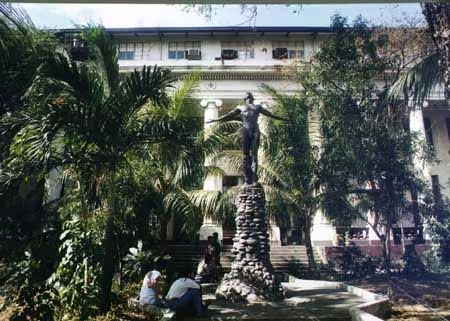
Owing to lack of financial resources, the plan for a separate building for the Population Institute as part of the Public Affairs Complex never materialized. In 1985, the UP administration required all graduate units to be located in the Diliman campus to make way for the transfer of the College of Pharmacy to the Manila campus. Hence, the Population Institute was provided permanent space at Palma Hall in Diliman and allotted part of the space occupied by the College of Pharmacy.